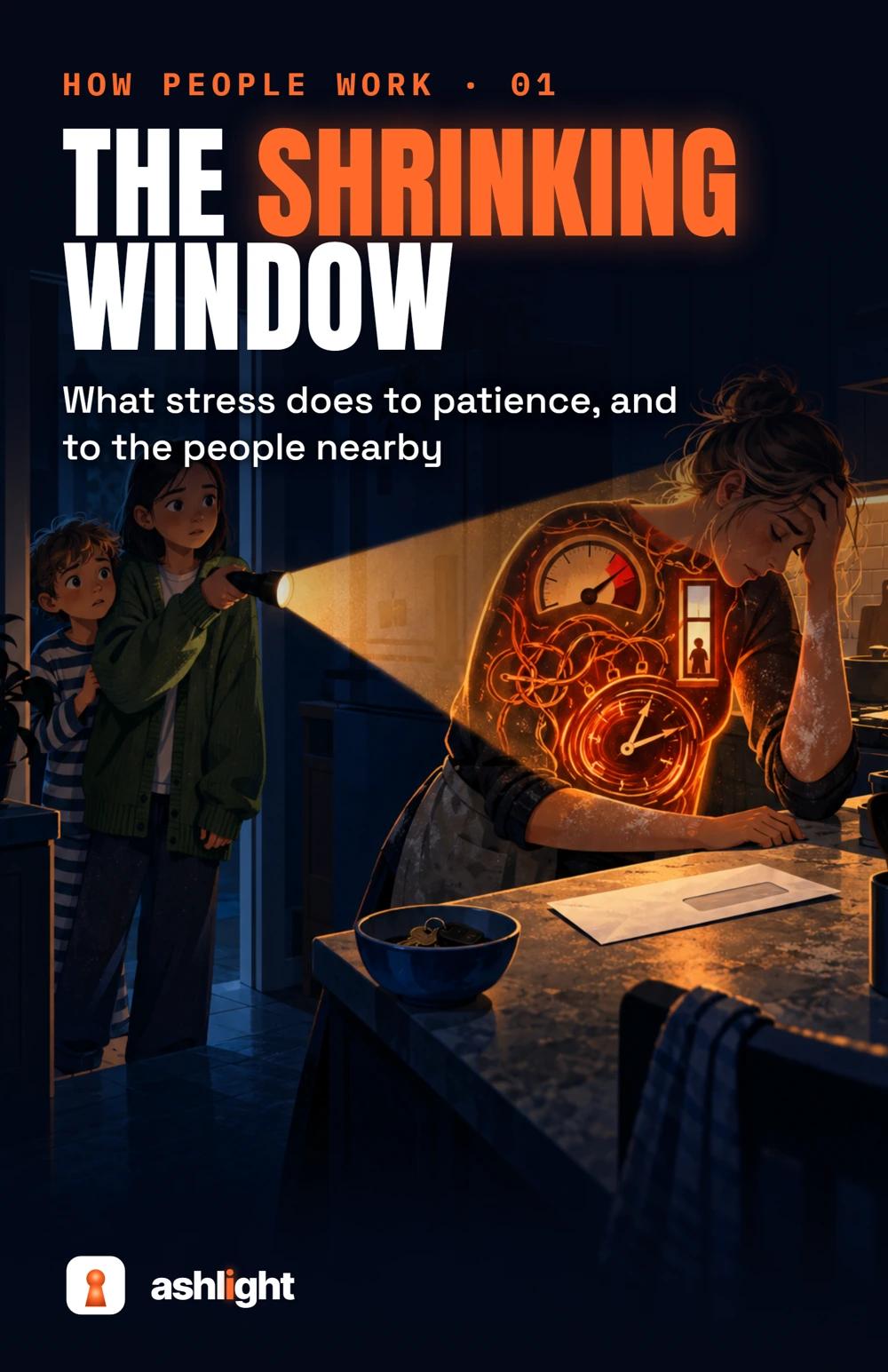
The Shrinking Window
About half the story. A closer look at what it means.The Story
The Weather Report
A note before you read
This book has two halves.
The first half is a story. It is made up. Mae, Juno, their mom and dad and the bee lady next door are invented people, and Harlow is an invented town.
The second half takes the story apart to show how it works. That half is not made up. Everything in it is about real people and real brains, and the back pages say where each piece comes from.
You can read the story and stop. You can read the second half first. You can argue with any of it. It's your book.
Mae Pruitt could tell the weather in her house before she opened her eyes.
Not the sky. The sky was the sky's business. Mae read her mom.
She read her by sound. If the coffee grinder ran in one long buzz, that was fine. If it ran in short angry bursts, bzzt, bzzt, bzzt, as if she were punishing the beans, that was not fine. If she hummed: sun. If the radio was on but she wasn't listening to it: clouds. If the radio was off, Mae stayed in bed an extra minute, because a quiet kitchen was the worst kind.
Then there were the keys. Her mom came home from the bakery every afternoon at four, and the first thing she did was put her keys in the blue bowl by the door. Placed: a clink. Dropped: a clank. Thrown: a crash, a skid, sometimes the keys on the floor, which meant everybody should find something to do in a different room.
In the back of her math notebook, behind the fractions, Mae kept a chart. Every day got a symbol. A sun. A cloud. A lightning bolt. She had been keeping it since March. She had never shown it to anyone.
Her little brother Juno did not keep a chart. Juno was seven, and Juno sang into his cereal. He sang the same song every morning, a song he had made up about a raccoon who becomes a dentist, and he sang it whether the grinder buzzed long or short. Mae could not decide if Juno was very brave or very dumb. Some mornings she wanted to protect him. Some mornings she wanted to put her hand over his mouth.
Their dad, Ben, didn't keep a chart either. He didn't need one. He was the calmest person Mae knew, a big quiet man who could fix anything with a motor in it and most things without. When the kitchen got loud, he got quieter, like a man walking into the wind with his head down. And after a storm, he was always the first one to knock on Juno's door.
It was the four of them in the narrow yellow house on Alder Street. Their mom, Nora, owned a bakery called Pruitt's, which made the best rye bread in the town of Harlow and almost no money. Mae knew about the money the way she knew about the weather. Nobody told her. She just knew.