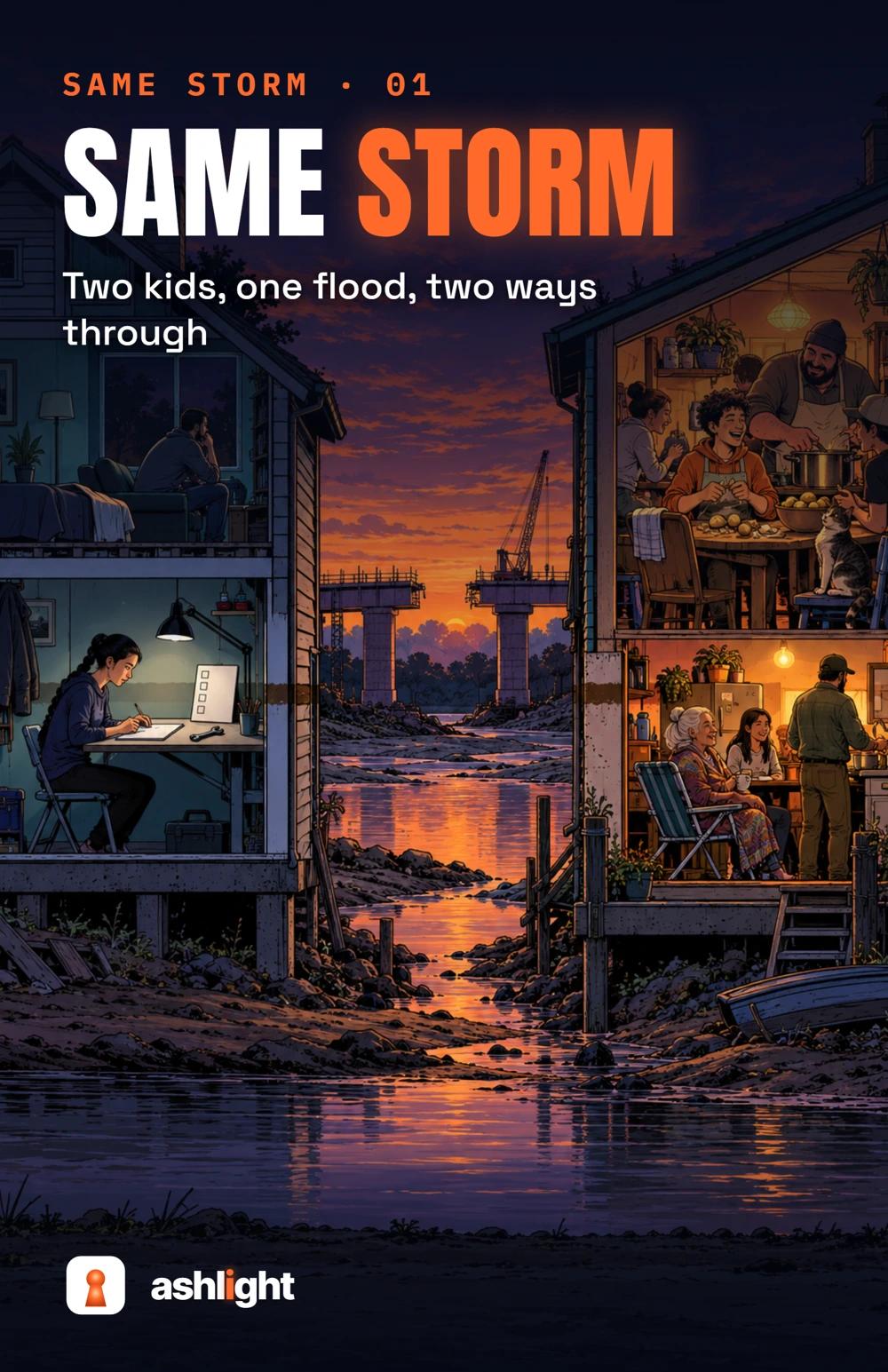
Same Storm
About half the story. A closer look at what it means.The Story
June: The Night the River Came
A note before you read
This book has two halves.
The first half is a story. It is made up. June, Teo, their families, the cook and the town of Corley are invented, and so is the Wren River.
The second half takes the story apart. That half is real: real studies of real kids, some of them followed for forty years. The back pages say where everything comes from.
The chapters take turns. One is June's, the next is Teo's. Read it in any order. Argue with any of it. It's your book.
The Wren River had flooded before. Everyone on the Low Road said so. It came up into the fields every spring, sat there brown and lazy for a week, and went back down. People on the Low Road didn't even move their cars.
So when June Albee woke up at two in the morning to her dad's voice in the hall, she didn't understand it at first. Her dad didn't shout. Her dad was the quietest man on the Low Road. He fixed tractors in the shop behind their house, and he hummed while he did it, and that was most of the noise he made.
"June. Shoes. Now."
She put her feet on the floor and the floor was wet.
Not damp. Wet. Cold water, over her toes, in her bedroom, on the second step up from the kitchen. June stood there in the dark and felt it move. The house was standing in the river.
After that it was fast. Her mom with a flashlight and the box of papers from the closet. Her dad carrying things out to the truck, then stopping carrying things, because the water was at his knees and the truck was all that mattered. June grabbed her backpack, her math book, and for no reason she could ever explain, a jar of peanut butter.
From the truck, on the high part of the road, they watched the shop go.
It didn't fall down. It just filled up. The big door was open, and the river walked in like it owned the place, and in the headlights June could see her dad's red toolbox, the one with his name painted on it, float up and turn slowly around.
Her dad didn't say anything. He watched until the headlights went yellow and the battery started to die, and then he turned them off.
He didn't say anything the next day either.
Or the day after that.