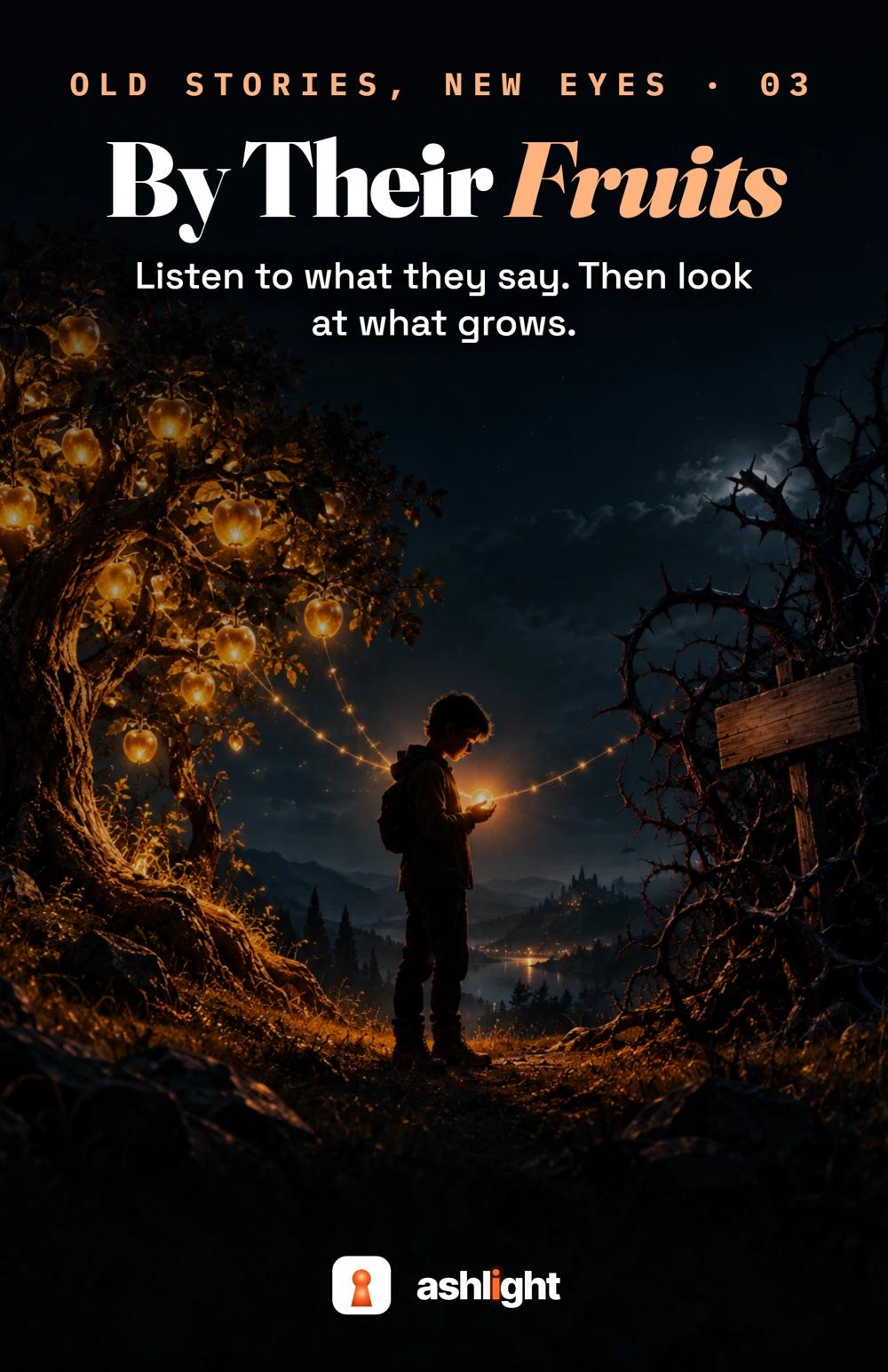
By Their Fruits
About half the story. A closer look at what it means.The Stories
The Two Trees
A note before you read
This book is made of old stories.
Some are from the Bible. Some are from the Buddha. One is from a Greek storyteller who lived 2,500 years ago, one is from a teacher who lived in your parents' lifetime, and one is a story everybody tells wrong. Each one is retold here in plain words, followed by a short poem and a plain look at what's going on in it.
The stories come from different places and different centuries, and they keep saying the same thing: don't just listen to what people say. Watch what grows.
The back pages say exactly where each story comes from, including which parts are really old and which aren't.
A long time ago, on a hillside in Galilee, a carpenter's son named Jesus was teaching a crowd. People had walked a long way to hear him. Some of them had also been listening to other teachers, men in fine robes who said beautiful things and who, it turned out, were mostly interested in what they could get from the people listening.
So Jesus told them how to tell the difference.
"Beware of false prophets," he said, "which come to you in sheep's clothing, but inwardly they are ravening wolves."
The crowd knew sheep and wolves.
"Ye shall know them by their fruits," he went on. "Do men gather grapes of thorns, or figs of thistles?"
Somebody probably laughed. Everybody there had been scratched by a thornbush. Nobody had ever picked a grape off one.
"Even so every good tree bringeth forth good fruit; but a corrupt tree bringeth forth evil fruit. A good tree cannot bring forth evil fruit, neither can a corrupt tree bring forth good fruit."
Later, he said it another way. "A good man out of the good treasure of his heart bringeth forth that which is good; … for of the abundance of the heart his mouth speaketh."
Then he stopped. He didn't tell them which teachers were the wolves. He gave them the test and let them go home and use it.
What's going on in this one
Jesus didn't say listen carefully to what they say. He said look at what grows.
Anyone can say anything. Words are free, and some people are very, very good at them. But fruit takes time. A tree can't fake a whole season. What a person does over months and years, how they act when they're tired or losing or caught, and how the people closest to them end up, is the fruit.
Two things are worth noticing.
First, fruit takes seasons. One bad apple doesn't make a bad orchard, and one sweet one doesn't make a good one. You're looking for the pattern, not the single day.
Second, "sheep's clothing" means the outside can be made to look like anything. A nice smile, a sad story, the right words in church or at school. That's why the test isn't the outside. It's the fruit.